Showing posts with label bioware. Show all posts

Friday, June 9, 2023

Beware Alignments

Yes, I'm aware that Bioware (well, EA) is selling Star Wars: The Old Republic to Broadsword. On the face of it, this sure sounds like the game is going into maintenance mode in the same fashion that Rift has been placed, but at least Broadsword isn't Gamigo. Some devs are heading to Broadsword from Bioware, and it sounds like Broadsword is basically two turntables and a microphone as far as development staff is concerned. That means that the SWTOR team will effectively move their culture over, lock stock and barrel, to Broadsword.

Given that I tend to play the "vanilla" areas of SWTOR with little interest in new content, I'm okay with that. (It would be nice if the devs brought out "Classic SWTOR" servers, but that's just me.)

However, one cautionary flag I noted were all of the comments here and there on the internet about how the SWTOR staff is moving to a place that aligns with their interests. Upon reading that, I twitched. You see, back in the early 2000s my division was outsourced to an IT outsourcing firm, and part of the justification in that outsourcing from my company's owners was that we would be in a place where our work is their primary business. Our careers would be better aligned with that new company, we were told, as we would not be a "back office" job but rather a core competency of our new company's staffing.

I said it then, and I'll say it now: that was a huge fucking load of horseshit. 

That was so much horseshit I could have been selling bags of manure for years.

The first thing that "new company" did was get all of everybody's workload and compensation, and then cut said compensation by turning everybody into to salaried employees. Then they began cutting people left and right to "align with the need to bring the account into the black".  Finally, they began offshoring positions overseas; first to Costa Rica, then to India and Indonesia, and finally to the Philippines.*

From makeameme.org.

In the case of history repeating itself, 14 years later our division was once again outsourced from that IT firm to yet another IT firm, and we were fed the exact same lines of crap about how our work would "better align" with the new firm. 

Guess what happened once we got settled into the new company?

From Digital Mom blog.

So yeah, I don't believe that bullshit for a single minute. And neither should the SWTOR devs.

If there is a silver lining to this, it's that Bioware will now have nothing to stand on other than their single player games that they've been doing just so damn well with. I mean, Mass Effect: Andromeda and Anthem were just fantastic releases, except for those damn SWTOR devs, amirite?


*When the Philippines office opened up, people on my team from India were suddenly concerned for their jobs, because the Philippines personnel were paid a fraction of their salaries, and they were underpaid compared to other IT companies in India.

Thursday, April 4, 2019

This is the New Normal

As usual Jason Schreier does a fantastic job of digging in and examining what went wrong with Anthem in a piece on Kotaku.

TL;DR: these sort of disasters are starting to demonstrate somewhat similar underpinnings:

  • Insistence on software engines not built for --or robust enough-- to handle the development process. This can be also known as the Frostbite Curse. EA's insistence on using Frostbite for all games --as a cost saving measure, among other things-- basically loses all cost savings as the difficulty in working with the engine adds time to the development process. Additionally, BioWare keeps "reinventing the wheel" with Frostbite in every large project, and never seems to settle on a "good enough" interface with the engine. The same problems that plagued Dragon Age: Inquisition and Mass Effect: Andromeda plagued Anthem. Admittedly some of those problems wouldn't have been able to be avoided unless BioWare gave Frostbite the middle finger, but others were definitely avoidable.
  • Not having a rock solid design. I'd call this the Destiny problem, as Destiny's disastrous rollout was due in no small measure to the constantly shifting aspects of basic game and story design. In Anthem's case, after the original concept went out the window, nobody could seem to decide on a story and game design; nobody seemed to know who or what Anthem really was. It was only when there was less than a year remaining until release that Anthem's design began to crystallize, but that was far far too late in the process.
  • Belief that since things had worked out in the past, it was always going to work out in the end. Crunch, that period of development when you're working insane hours trying to get the product out the door in reasonable shape, happens with all software houses. Some software houses, such as Naughty Dog, are legendary for having brutal crunch periods. BioWare is no stranger to crunch, but the crunch of Dragon Age: Inquisition was particularly bad, and the result of a DA:I that won awards in the game industry gave BioWare's management the idea that if they just crunched hard enough the old "BioWare Magic" would work wonders and they'd get a great product in the end.

    I've been in software houses that believed that sort of thing, and I'm here to tell you that crunch like that does no favors to either management or the devs. The devs get burned out, and management buys into the false belief that they can keep doing this indefinitely. Apparently, the crunch for Anthem was so bad there were fairly large numbers of people who had the equivalent of a nervous breakdown and had to simply stop showing up to work for months at a time. A lot of experienced developers and senior staff quit. And maybe, just maybe, BioWare finally learned that you can't push devs too hard or bad things happen.
  • Infighting between development staff. The Edmonton and the Austin BioWare studios were often at odds on Anthem development. Edmonton called the shots, and although Austin had a lot of experience in similar games with all of their work on SWTOR, all of their suggestions were repeatedly shot down. You'd think that when the MMO devs are telling Edmonton that "hey, we've been down this road and here's how to fix it", Edmonton would listen. But that was frequently not the case.

    Again, I have experience here, and it's never fun when you end up feeling like Cassandra right before that wooden horse is brought behind Troy's walls.
  • Interference from the Big Dog. People kind of expect this at EA owned companies, right? Only that pretty much all major development houses are doing the same thing now, from Activision Blizzard to EA to Bethesda. The decision to use Frostbite is due to the EA bigwig who is VP over the division that makes Frostbite. The decision to not budge from the March 2019 release date is because of the end of the fiscal year for EA, not because BioWare or EA thought the game was ready for release. If anything EA should have let Anthem slide into June, giving the devs and extra three months to fix bugs and add material to the game, but EA wanted the release on its balance sheet for the last fiscal year, and they got what they wanted. The entire "games as a service" model --and EA's particular disdain for single player games that you play once and you're finished-- have also had their impact on Anthem.

    But what is likely one of the worst parts of the EA interference was the time when FIFA was migrating to Frostbite, and because FIFA makes EA a metric ton of money to the tune of a couple of orders of magnitude of cash from BioWare's releases, EA sucked away all the Frostbite experts into helping FIFA get out the door, right when Anthem really could have used them the most.
I could go on, but you've got the idea. After Fallout 76 and Anthem, and the associated Bungie divorce, the major development houses aren't exactly in the good graces of gamers. But here's the thing: if gamers think that they have a say in how the dev houses are run, unfortunately they don't. The major dev houses make a lot of money on games that the hardcore gamer likely turns their nose up at: the annual Madden or FIFA releases, the latest Call of Duty iteration, or the tons of mobile games. The big dev houses don't cater to the hardcore gamer, but rather the investor first and then the type of gamer that Gevlon would call the "morons and slackers". Sure, it doesn't have to be this way, but it's only when the investors start to get antsy will things change with the major dev houses.

And frequently, those changes are not for the better.

Saturday, December 22, 2018

You're Almost Old Enough to Drink

Twenty years ago on December 21st, 1998, a computer RPG by a little known software company named BioWare was released to the world. That computer RPG would go on to revolutionize and revive the Western style RPG.

Happy birthday, Baldur's Gate!

One of the many classic lines from Baldur's Gate.

And another....


And the source of the best quotes in the
game, Minsc (and Boo)!

Friday, October 12, 2018

A Quick Friday Read

I came across this recent post from Eurogamer about how BioWare completely changed the RPG genre with Baldur's Gate, and found it too good to not share. It's full of the "we had no idea what we were getting into" moments, along with how the game was so incredibly massive for its time. Nowadays, it'd be considered fairly small, but I remember playing the game and having to constantly swap out the 5 CDs that the game came with. I got used to hearing the very specific mechanical sound of the CD player that meant "Hey, I found something relevant", and when it requested a new CD I felt the urge to cheer.

Fun fact: Dynaheir (above) was
voiced by Jennifer Hale. Yes,
Jennifer "Fem Shep" Hale.
From baldursgate.wikia.com and
BG itself.

While I do think that BG2 improved upon everything that the original BG had, were it not for that first Baldur's Gate the entire RPG industry would be completely different, and likely dominated by Final Fantasy clones.

But for me, the best part was finding out the inspiration for Minsc and Boo, which while a bit more mundane than I expected I still found amusing.

From the baldursgate.wikia.com site,
as well as Baldur's Gate itself.


Wednesday, August 22, 2018

A Pleasant Musical Surprise

Given that I play SWTOR and other Bioware games, and that I'm surrounded by musicians in this house, it's no surprise that I found this blog post from Bioware the other day fascinating:

New World, New Score: Announcing Sarah Schachner as Anthem's Composer

Hey, I'm always up for a compelling musical score, and it really looks like Schachner's compositions for Anthem certainly fit.

Sarah Schachner, who has also worked on
Call of Duty and Assassin's Creed games.
and for a link to the Soundcloud of the sample piece, Valor (Freelancer's Theme), here you go:


For me, the didgeridoos and drums really make the piece move.

Friday, March 30, 2018

Enough to Give You Flashbacks

I spent this past week sick. As in, "I should have been in bed but work wouldn't let me" sort of sick.*

While that didn't exactly help me with keeping up with the blog (as well as playing games), I did have time to finish up a book on the video game industry. For people who read Kotaku, the name Jason Schreier should sound familiar, and his book Blood, Sweat, and Pixels is a look behind the development of several video games. While none of the games featured were MMOs, several of the games were those developed by game companies that do develop MMOs, such as Bioware and Blizzard.

And if I thought that his article on the disaster behind Mass Effect: Andromeda gave me flashbacks, this entire book was akin to reliving a five year stretch of my life.
This pic popped up when I searched Google for
"generic software developer working photo".
In my experience, these people can't be
actually coding at that time because they're
all smiling. (From thebalance.com.)

Video game developers are a breed apart of most other software developers. While I used to hear stories of the earlier days of Microsoft when upper level managers would roam the hallways, complaining that too many people had gotten married or had families for Microsoft to keep their edge, video game developers pretty much lived for writing code 24x7. A coworker of mine was once on the dev staff for Betrayal at Krondor, and the stories he told of the insane hours worked made for good lunch discussion.**

And the stories that Jason told in his novel really hit home for me, such as:

  • The doomed Star Wars 1313, the game that was going to restore LucasArts to its former glory but was destroyed by micromanagement from the top (George Lucas) and the sale of LucasFilm to Disney. This reminded me of my company's attempt to capitalize on the rush to get everything on the web by creating a "web based midrange CAD program"***; which was great in theory but was about 10+ years away in terms of bandwidth and raw computing power. All his initiative did was suck up resources when they were much better spent getting the last major release of our CAD software bug free (it wasn't, and the product when shipped was a disaster). There was even a last ditch effort by a sympathetic EA executive to try and save the LucasArts team and 1313 by arranging a 1313 presentation to another of their studios, but that ended in defeat when the head of the studio was only interested in acquiring the talent and not the product. And that reminded me of when my company was finally acquired, and I could only watch from afar as friends I'd known for years were let go in the massive bloodletting at was once a proud development and engineering house.
  • The redemption of Dragon Age: Inquisition, after the poorly received and hastily thrown together release of Dragon Age 2 (which was originally intended by Bioware to be called Dragon Age: Exodus, but EA forced them to say "2"). The original sequel to Dragon Age: Origins was meant to be Inquisition, but because SWTOR was slipping in the release schedule the corporate parent EA wanted to release another Bioware game instead, and so the dev team had to rush in and create what became DA2. The failures behind DA2 really weighed on every aspect of the work on Inquisition, as Bioware wanted to prove that they were more than just a Mass Effect studio with some other games of lesser quality. As a side effect of both DA2 and ME3, Bioware also had to handle corporate pushback as to whether they should really do the ME3 extended ending. Bioware wanted to get it right, but corporate looked at it as essentially feeding the trolls.
  • The lonely development process of Stardew Valley, where Eric Barone labored for years to get what he felt was a "good enough" product for release, to the point of nearly working himself to death. Even when he released Stardew Valley, he had no idea whether the public would think his labor of love to be any good. That crippling self-doubt plagues a lot of creative types; I see it from software developers to musicians to actors to painters, and yes, I've seen it in the perfectionism of the mini-Reds when they practice their instruments.
  • The eventual trainwreck behind Destiny, and the real reason behind why Peter Dinklage sounded like he mailed it in during the voice acting. (Not Quite A Spoiler Alert: it wasn't his fault.) As well as Activision/Blizzard's corporate handled the Diablo 3 fiasco (another chapter), it didn't handle Destiny's problems quite so well.
  • The soul crushing doubts that drove the Witcher III development, and whether the game would be good enough to meet the standards of Western RPG developers/fans, not to mention whether there would actually be enough content in the game to not have long stretches of simply "not doing anything".
I could go on and on, but the entire book is filled with stories about many games we video game players know, and yet don't truly know because we've not peeled back the curtain to what lies behind the game.

Blood, Sweat, and Pixels provided me with a bit of catharsis. I used to work in the software industry, so I know what it was like to be in their shoes. At the same time, I realize that is the sort of work that is by far a young person's game, because I'm more interested in trying to keep my work hours down to reasonable levels. I have become the "married guy with kids" that so upset Microsoft's old management, and as a consequence I want to step back from the intensity (and insanity) behind software development and enjoy more of the fruits of their labor.

But it has also increased the respect I have for the devs who make these games. I already had a lot of respect for their work having lived it, but you'd have to take my old job and crank it up to eleven to get what crunch**** is like for them.

So I'll raise a glass to Jason for a very well written book, and another glass to the devs who put together these games.


*We do have "sick days", but there were too many deadlines that were suddenly foisted on us this past week to take time off.

**He also used to tell us "you don't know how good you have it here, as we'd be sleeping on cots to finish the release."

***The midrange CAD/CAM/CAE market was above the level of Autodesk. Software in that range is what is used by major corporations to design products, such as CATIA or Pro/Engineer or Unigraphics. These are the software packages that auto companies use to design cars and electronics firms use to design televisions.

****Another dev term. We used to simply call it "hell", as in "we've got another hell week ahead if we want to lower the amount of bugs to acceptable levels."

Friday, January 26, 2018

Playing Buzzword Bingo

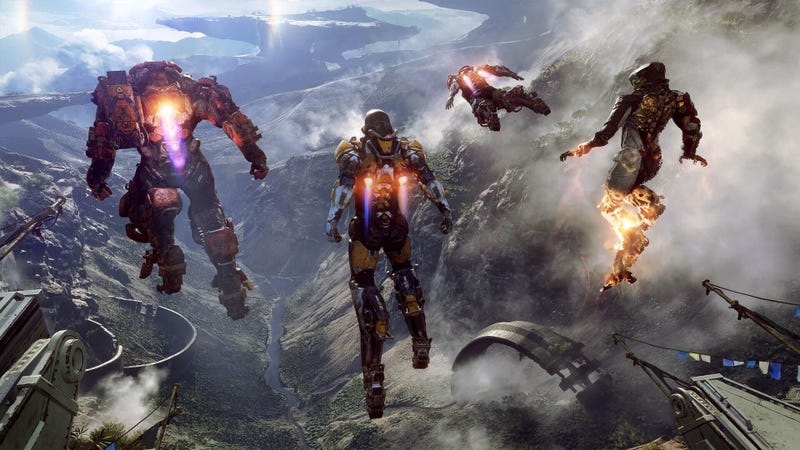
I read with great interest the Kotaku article Bioware Doubles Down on Anthem as Pressure Mounts by Jason Schreier. Basically, Bioware is devoting a ton of resources to make Anthem, their equivalent of Bungie's Destiny, with only a few small development teams working on Dragon Age 4 and SWTOR. The overall feel within Bioware is that the success of Anthem is a make-or-break moment for the company, and if it isn't a success this might be the end of Bioware as we know it.*
Remember, the fate of hundreds of employees
is riding on your ability to write bug free code.
From Kotaku.com

The sense of a single release having so much of an impact on a game company's fortunes isn't exactly unheard of. Some people were looking at Zelda: Breath of the Wild as Nintendo's last chance to remain relevant in the console wars with the Switch's launch fortunes tied up with the game's release. On the flip side, Microprose's Darklands release back in the early 90s was such a gigantic disaster that it nearly destroyed the company that released Sid Meier's seminal games.
Remember when people were saying that
Nintendo should get out of the console market
entirely after the "failure" of the Wii U?
Yeah, I don't hear that anymore either.
From zelda.com.

Still, it sounds like the struggles with the EA imposed "single solution" of the DICE Frostbyte Engine haven't ended for Bioware. Compared to Unreal, Frostbyte is the muscle car of Engines in that it does one thing well but has... issues... when being expanded into areas where Bioware excels: RPGs. They had issues with Dragon Age: Inquisition and Mass Effect: Andromeda, and it seems that these issues are now continuing in Anthem.**

To MMO players, the fact that Bioware is keeping development of SWTOR going in the face of the "all hands on deck" approach to Anthem is a good thing, but the fact that they had a discussion about putting the game in maintenance mode isn't.

But I made the mistake in reading the comments in Jason's article, and that got me annoyed.

***

A lot of the comments center on a few key points:


  • EA is Evil (as in Disney Villain Evil)
  • Bioware isn't what it once was
  • Anthem will suck because of microtransactions and lootboxes
A lot of the negative comments really break down into variations of "EA is Evil", even when they're talking about the superiority of CD Projekt Red over Bioware in creating RPGs they're basically saying "EA ruined Bioware and EA is Evil!" 

But the thing is, EA isn't Evil in the standpoint of being purely malicious, but rather EA is doing what it does because of their own external pressures. 

Every publicly traded corporation has to deal with the pressure of "what have you done for me lately?" sooner or later. Sure, you get that from your customers --gamers in particular are a prickly lot-- but far more stress comes from investors. If you have a breakout hit, investors will expect you to continue your streak. If a competitor does something that breaks new ground and rakes in a ton of profit, investors will expect you to respond. And not just in a year or two, but yesterday.***

In that vein, the rise of mobile games and the F2P cash shop haven't exactly been helpful to more traditional video game companies. The volume of money made by microtransactions in the mobile arena has inspired Wall Street to push for more monetization of games, while the cash shop has demonstrated that it can keep MMOs afloat in a F2P/post-subscriber world.**** RPGs and MMOs are more expensive to create than this year's edition of Madden, and if they don't make a huge splash the development corporation is left holding the bag. And believe me, Wall Street knows it.
Yes, here's the obligatory quote from Gordon Gecko
in Wall Street (1987). And remember, even more people
agree with this now than they did 30 years ago.
Isn't that a real kick in the ass? 
From giphy.com.

The reality that Wall Street and the pursuit of short term profits are driving the monetization of games and pressuring developers to release on a tight schedule doesn't let corporate management off the hook. People aren't exactly going to be crying for EA's management or Activision Blizzard's Bobby Kotick, and you can make a pretty damn good arguement that good games are released in spite of them rather than because of them. But this is the new way of doing things in corporate development houses. If you're not under extreme pressure to release a buggy product early,***** it could be that your development house is a wholly owned subsidiary of a console maker (such as Horizon: Zero Dawn's Guerilla Games or Nintendo itself) or that your development house doesn't get the spotlight shone upon it by Wall Street, NASDAQ, or the Tokyo Stock Exchange (such as CD Projekt Red, which is on the Warsaw Stock Exchange).

Does that mean that we have to like it when EA gets DICE to slip in microtransactions like they did in Star Wars Battlefield 2? No, but it also doesn't mean that they're tools of Satan, either. Until the economics driving the video game industry change, don't expect video game activism to suddenly convert these corporations into the second coming of Ben and Jerry's. Besides, even Ben Cohen and Jerry Greenfield sold their socially responsible ice cream company to Unilever.

Video game companies can change the way how they do things and tell Wall Street they're not going to chase the last dollar or euro but instead invest for the long term and release when they're ready to do so. You know, like Blizzard does.

But it certainly helps to be able to print money like Blizzard can with WoW (and to a lesser extent Overwatch). Oh, and remember that WoW and the MMOs that preceded it convinced a gamer community that it was okay to actually subscribe to a game rather than simply play it offline like almost all other games that came before. That monetization can be a real bitch, sometimes.
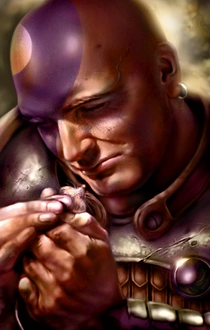
Remember these guys? Mr. Redbeard does.
From Reddit.com.


*Some would argue that the Bioware as we knew it was already gone after ME2 and Dragon Age: Origins, but I don't quite buy that. Bioware still wants to go all in on RPGs as much as they can, but external pressures are forcing them in other directions.

**And I thought that the engine used in SWTOR was considered clunky and difficult to work with!

***When you hear corporate speak about "agility", this is what they mean. In my experience, however, the other corporate standby, "lean and mean", doesn't mesh well with "agility". You need bodies to be agile enough to change direction, and corporations that typically operate as "lean and mean" don't have any spare bodies out there to spearhead that change. (OOO!! Spearhead!! Another corporate slang term! Has anybody won Buzzword Bingo yet?)

****See: SWTOR, LOTRO, Star Trek Online, etc.

*****Or release with tons of microtransactions and other monetization schemes.

Tuesday, January 9, 2018

Full Plate and Packing Steel

Guess what I've been playing with this past week?

A certifiable blast from the past.
Yes, the second game Bioware ever created, Baldur's Gate.*

I played BG back in late 1999-early 2000, when a friend loaned me the 6 CD set.** There's a bit of a slow part in the mid area, when you're trying to get to a high enough level to gain access to the city of Baldur's Gate itself, but so far the game has really aged well in terms of storyline.

Sure, the sprite images look ancient, but the gameplay remains surprisingly intuitive. The environment simply fits with the D&D system, and it's not hard to pick up and start playing. And boy, the core rules are pretty unforgiving when you use them here. 

I'm up to Chapter 3 --not an "already??" moment, because you spend a lot of time raising your level by doing side quests-- and I've found that I really had to stuggle to get through the end of the Nashkel Mines dungeon. I became reacquainted with the "rest" feature in the area where the soldiers are posted, because otherwise we'd not have enough spells to make it through. And that last fight...

Hoo boy.

I can't wait to keep going.


*I always figured it was the first game, but it turns out they created Shattered Steel first.

**That dates BG right there; you learned to listen for the change in the CD access sound so you knew what event was about to happen.

Friday, August 25, 2017

Years in the Bunker

In case you hadn't noticed, Ophelie of Bossy Pally is back posting after an extended hiatus. She's been focusing on single player games these days, and she's been working her way through the Mass Effect series.

Her most recent post was about single player versus multiplayer games, their profitability, and the potential future of Mass Effect titles. While I think that ME will make a return after the bones of the system (the Frostbite engine in particular) are fleshed out enough to accommodate the RPG that Bioware wants to create, the lure of cashing in on ME style multiplayer might pull the game in a direction that fans of Bioware RPGs might not like.*

That said, a link to this article by Kotaku author Jason Schreier really caught my eye. It was a detailed article on the development process for ME:A, and everything that went wrong in development. (TL;DR: a LOT went wrong.) Schreier even mentions in the article that it was amazing that ME:A actually shipped at all, given all of the issues with the development process.

But for me, reading the article felt like deja vu.

***

As I alluded to in a previous post about the potential issues of new software releases, I worked for several years in a software development house. Those five years were some of the best years of my life, when I worked hard for bosses that both pushed me beyond what I thought my limits were and yet respected my effort and output. I made some friendships that are still going strong today, and the skills I learned during my years in the barrel (so to speak) still serve me well today.

But those five years were also among the most stressful I ever experienced.

When you're on the inside of a development house there is an occasional tendency to get consumed with the work that's right in front of your face. Teams who work together day in and day out develop the feeling that their (piece of the) project is the most important part and frequently miss warning signs. But if you can break out of that silo, you can also see a train wreck coming a mile away. Sometimes it's salespeople who overpromise to critical customers without asking in advance "can we do this?"; sometimes it's the defection of critical personnel that a company had relied upon for years as a hero to fix the emergencies at the last second; other times it might be the promotion of people who prove to be incompetent at managing a development team; and then there's the occasional directive from the top to change direction in a project. Sometimes you might just get three or even all four.

I've been in good releases and bad releases, but the one that still haunts me is the last release I was involved in, which was a real shitshow.

This particular release was a perfect storm of overcommitments to customers, loss of senior staff to higher paying jobs**, an inflexible deadline set by said commitments, and major stability issues with the development environment. In spite of all of the (new) development staff we had, there were personnel shortages during the entire release cycle as the company had underestimated the new devs' capabilities.*** I was our team's representative on the weekly release meeting, and every week there were major complaints from all of the QA teams about the quality and stability of the product. We felt that the product needed at least 2 months to straighten out all the bugs, but we were informed by upper management that was simply not possible.

Things were so bad that they had to create a tiger team dedicated to simply having a workable daily environment for devs to code with, because every other day it seemed like some new code change would crash the entire system. I got drafted into that team for a couple of months, and I lost a lot of sleep because my pager (remember them?) would go off multiple times a night letting me know that a build had failed and we needed to find what code change broke the system.

In the end, you can kind of guess what happened: the product shipped, it was incredibly buggy, and the company took a lot of flak for it. A year and a half later, the company was gutted of "overpriced personnel" and sold to a competitor.****

So yeah, I know what it's like to be in Bioware's shoes with the result of the ME:A release.

***

The thing is, the development cycle didn't have to be that way.

Blizzard is practically alone in not announcing a release date until it feels that the software is ready to go. But that's because while Blizzard has given themselves a ton of goodwill from the gaming community over the years, they have also their reputation as a producer of good and stable games at stake. Of course, they have had their share of release fiascos lately --such as Diablo III and Overwatch-- so they're not immune to problems either. But I do believe these issues also stem from the pressure that Activision is placing on Blizzard to release on a regular schedule, in much the same way that ME:A would have benefited from an extra year of work rather than release on a date set long in advance (whether internally by the staff or externally by the suits).

The ME:A release disaster was another perfect storm of staffing, management, focus, new tech, and time. And the Bioware Montreal office paid the ultimate price by being shut down and absorbed into EA Motive. But this disaster should be used by Bioware to focus on the weak points and improve them, not to go and hide. Shelving the (single player) Mass Effect franchise would be the wrong solution to the problems of ME:A.

Now, if only the suits would let Bioware work out the solutions...


*Think of it this way: Blizz was known for the Diablo, Warcraft, and Starcraft franchises. Now, along comes Heroes of the Storm, Hearthstone, and Overwatch. The money that Blizz gets out of the latter three have muscled aside the original three, and so guess where the development dollars go? While WoW still pumps out content but it is no longer the star of Blizzard's lineup, and that means that WoW will take a back seat to content for the new titles, which are correspondingly cheaper to develop and maintain. (Such as a lack of story content to the level that WoW/Diablo/Starcraft have.)

**This was the late 90s, when the original dot com bubble was inflating rapidly. I knew several of these people very well, and almost all of them cited the desire to a) make more money and b) feel appreciated. While this may sound at odds with my statement as to how I was respected, you have to realize that these people had been taken for granted by management that they'd be around to clean up everyone's messes. They'd been around for a decade or longer, and they'd realized that the internet revolution was passing them by, so they jumped ship.

***The new devs also had an alarming lack of discipline. If they were assigned to work on boolean logic issues, we'd frequently find them deep within the mathematical algorithms instead, claiming that they wanted to see where the bug led them. We had to explain numerous times that it's not your job to worry about the algorithms, we have an entire math team to handle that. Hand the bug off to them and let them deal with it. Curiosity is one thing, but when you've got 10 bugs to work on and you need to get them fixed in 3 days you don't have the luxury of drilling down past the code you know.

****By then I'd already left the company, as everybody could see that the CEO was going to cash in by selling us and getting his golden parachute.

Wednesday, March 29, 2017

On Releases and Glitches

I've been watching the launch of Mass Effect Andromeda with more than a passing bit of interest, even though a) I'm not even finished with the first Mass Effect game, much less the entire trilogy, and b) I don't really have the money to drop on a new game.*

Still, the armchair quarterback in me has been following along with the hype and inevitable problems at the game's launch.

You know the old adage "Fool me once, shame on you, fool me twice, shame on me"? This definitely applies to software releases these days. Even the supposed gold standards of software development and release, Blizzard and Apple, have had their share of software launch bugs.

This makes me wonder why someone would even bother buying the game at launch, much less pre-ordering, when you know that bugs will frequently be the reward of playing the game first. Another way of putting it is "Why pay to be a beta tester?"

Sure, you may get extra goodies such as an extra in-game item or the soundtrack**, but is it truly worth the headache of dealing with a game that is frequently in need of major patches to even make it enjoyable?***

***

In the case of Mass Effect Andromeda, there are bugs, and there are features.

The bugs are the obvious items: system crashes, graphical glitches, selections that don't work, etc. You know, the usual stuff.

But features, those are design decisions that may seem like bugs but aren't.

There are animation glitches in Andromeda, no doubt, but the overall look and feel of the animation is not a bug or a glitch. That was a design decision.

I'm reminded of the behind the scenes extras in the DVD release of The Incredibles. In the video article, they were talking to Pixar developers and engineers about the technical leaps they had to make for The Incredibles to work. As it was Pixar's first animated movie with an almost exclusively human cast****, they had to expand their technical capabilities to get certain aspects of animating humans right. At one point during production, one of the engineers had to go to John Lasseter (the head of Pixar) and tell him that "at the moment, hair is still pretty much theoretical." The concept of having hair move properly when animating a human --whether that hair is dry or wet or in a convoluted design-- confounded the developers for a long while.

And in the work surrounding Mass Effect Andromeda, the scale of the game meant that Bioware likely had to determine what priorities the developers worked on, and what aspects of development they were going to use an off-the-shelf or generic solution for.

This isn't exactly a newsflash to people who have worked in software development; in my time at a software shop we handed translation from our software's format to other formatting standards --akin to converting from JPG to PNG and back-- to a third party. The trick was to integrate the third party's software into our existing package seamlessly, and that was not as simple a task as you might think. The number of bugs that resulted from that integration was... pretty large at times. A lot of times it had nothing to do with the third party software at all, but with coding in a completely unconnected part of the software.*****

What does all this have to do with the facial and character animation? My speculation is that part of the Andromeda animation wasn't a high enough priority to deal with as an internal project, and so Bioware used an off the shelf product to handle the animations. And the issues with the facial and character animation could be due to a) integration with the main software, b) the third party software needing tweaks to work better with the overall product, or c) the third party software is being asked to handle something that might be beyond its current capability.

Or maybe a combination of all three.

But this isn't just my speculation, here's an Animstate Roundtable which included professional animators discussing this very issue, pointed out by an article from PCGamesN and Gamasutra. The entire roundtable is interesting, but this part I found resonated with me the most:

"Simon: Before I speculate on what the cause of these animation issues are, I think it’s important for people to understand some of the numbers behind a game like this. I don’t have exact figures from ME:A, but we do know that Mass Effect 3 had over 40,000 lines of dialogue and Dragon Age had about 60,000. If we split the difference at 50,000 and conservatively estimate that each line averages out to about three seconds, that puts us at around 41 and a half hours of dialogue. That’s about 21 feature films worth of just talking. Most of the major animated feature films have a team of about 70+ animators working for two or more years to complete just one movie. A game like Mass Effect might have somewhere between five and ten focused on more than 20X the content in the same amount of time. To add to that, we need to also factor in localizing (translating) the game into at least 4-5 additional languages.

Now, it’s just not possible to keyframe that amount of content to any acceptable level of quality, so teams looking at that much scope try to find procedural solutions. I know in the past they’ve used an off the shelf solution called FaceFX, which analyzes the audio tracks and creates animation based on the waveforms, projection, etc. At a base level, it can read as a very robotic performance and I suspect that is what we’re seeing in some of the footage. You can work with the audio and the procedural tools to polish the performances in various ways of course, but when you’re staring down thousands of minutes of performance to clean up, your definition of “shippable” is a sliding bar that moves relative to team capacity and your content lock date. If it were my team and project, I would try to gather metrics on which scenes were the most watched based on playtest and use whatever polish time I had with those as a priority, letting the lesser seen ones go with a default pass." --From Animstate.com ROUND TABLE – MASS EFFECT: ANDROMEDA

***

Back to the original thought behind this post, why bother buying a game at launch if you know there's glitches and/or features that need to be cleaned up? Part of that is, I suppose, faith in the development house to get the job done right. Or if not done right initially, then to fix the problems quickly. Reputable development houses don't just sit on problems, they fix them.

And another part of this is the reality behind software development. It is much more complex than, say, building a fence or even a car, and constant tweaks in response to unforeseen problems is pretty much par for the course.

And finally, there's also the recognition that very few software development houses announce a release when they feel it's ready --okay, it's Blizzard-- and that when a release date is presented to the public there becomes an enormous amount of pressure to meet that date. The company doesn't want to lose face to its investors, the investors are constantly asking each quarter "What have you done for me lately?", and the development staff doesn't want to disappoint the fans. For my money, Blizzard does it the right way, but even they aren't immune to the occasional bad release.

From my perspective, I have absolutely no need to rush in and buy something the moment it is released, so I'm content to wait. I did that once, when I bought the original AMD Athlon system back in 1999, and six months later I could have paid about $600 less for the same system. I learned my lesson that time, and I've not wavered from it.


*Yes, I'm quite aware that you don't need to have played the original ME trilogy to have played Andromeda, but it provides a good buffer to rushing out and buying the game from the get go. Besides, immersing yourself into the world of Mass Effect prior to playing Andromeda isn't necessarily a bad thing, even without the Geth or Reapers.

**Okay, I can understand the soundtrack enticement.

***I'm not a fan of the Assassin's Creed series, but the bugs of Assassin's Creed Unity are infamous among gamers.

****I kind of count the robot as a minor character.

*****Okay, I'm going to get a little technical here, but in C and C++, memory allocation is a huge thing. If you don't do it right, or you go beyond your allocated memory, you could end up overwriting whatever else is in memory. It's very powerful, but it is also dangerous. If you don't clean up your memory allocations, you end up with what are called "memory leaks". And eventually that will kill your performance and potentially cause crashes of software or the computer/server. The greater the complexity of the software, the harder it is to find these memory leaks by yourself and you have to rely upon --you guessed it-- third party software that shakes memory leaks out. But the fun doesn't stop there, because something might be working perfectly fine in its "leaky" state, and once you fix it the function/code stops working right. And then you have to go find out why that's the case, and maybe you find even more memory problems underneath it.

Java has this problem too, and that's why a lot of Java implementations --especially early ones-- have so many memory problems.

Thursday, November 3, 2016

How often can you connect a video game with They Live?

The voice of Captain Anderson in Mass Effect is provided by prolific actor Keith David. For some people, he is also the voice of Goliath in the cartoon Gargoyles. For others, he's found in John Carpenter's films The Thing (Childs) and They Live (Armitage). And still others, he's known for his voice work in Halo, Saints Row, and Call of Duty.

But probably his best known current work in the US is something that's rarely heard beyond our borders.

That's because Keith David is the narrator for commercials for the US Navy.


It may not be well known outside the US, but the US military is an all volunteer force. Since they don't rely upon a draft to staff the military, each branch invests heavily in commercials and outreach.

And that includes television commercials.

So when I hear Captain Anderson in Mass Effect, I have this weird juxtaposition of Mass Effect and the US Navy.


This makes me wonder if people who are used to Jennifer Hale's voice in Mass Effect and other video games have flashbacks when they hear her voice as the SWTOR female trooper.

Sunday, January 31, 2016

If I Could Jump Like That, I'd be in the Olympics

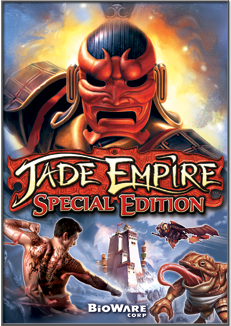
Origin has had another of those classic free games available that fell under the "yeah, I've kind of wanted to check this out" header: Jade Empire.

From origin.com. And yes, the freebie is Special Edition.

Thankfully, this 2005 release will run on modern widescreen monitors --even though the cutscenes are all 480i-- so it doesn't seem too out of date.

Yes, the old Bioware engine is a bit ancient compared to today's software, but the story is all there. And yes, it is a really good story.

(Well, duh. It's Bioware, right?)

After having played MMOs for so long, reacquainting myself with the "Save" feature was a bit of a shock. As well as dying on the second or third fight.*

Unlike its Bioware predecessors, Baldur's Gate 1 and 2, Jade Empire is made for the console controller first and the keyboard second. It has that Neverwinter design of using keys to move around and the mouse buttons to shoot, and after a couple of days my knuckles have begun aching. I think I'm going to have to break down and get a replacement XBox 360 wireless controller unit for the main PC, as the old one simply stopped working about 3-4 months ago.

Aside from those quirks, Jade Empire is shaping up to be a satisfying RPG.

I do wonder how Jade Empire would look if it were updated graphically to match the modern designs, however.

***

The reason why I bring up Jade Empire is that it's another property that makes me wonder how it'd work as an open world MMO.

Of the current AAA designs, the only one that has an explicit Wuxia connection of any sort is WoW's Pandaria expansion. I don't count Final Fantasy XIV, which is high fantasy (mixed with some steampunk), and I never played the Age of Conan expansion into Khitan. Other JRPG-influenced MMOs, such as Aion, don't cross into Wuxia territory.

There are some martial arts MMOs out there, such as Swordman and Age of Wushu, but neither command the level of interest that even SWTOR or LOTRO have. There was also 9Dragons, but it is shutting down in February 2016.

Still, it seems very odd that a genre that people are very familiar with, courtesy of Asian martial arts movies, the occasional breakout film**, and the numerous martial arts fighting video games, is underrepresented in MMO space.

***

One last non-related note:

Apparently Splatoon's Squid Sisters, Callie and Marie, have been branching out beyond providing the "news" when you login to Splatoon. To wit: they held their own Vocaloid concert recently, and there is a YouTube video of the event.


No, really. Apparently these Vocaloid concerts are a thing in Japan.


*I also reacquainted myself with some more esoteric language in my vocabulary.

**Like Crouching Tiger, Hidden Dragon. Or even the Kung Fu Panda trilogy.

EtA: Added the video.