Showing posts with label shortwave. Show all posts

Wednesday, August 27, 2025

My Adventures Over the Airwaves Part 2: On The Beautiful Blue Danube


I used to listen in at 5:00 UTC to Radio Österreich
International on 6155 kHz. It was broadcast to
Europe, but was an easy catch for those of us living
in Eastern North America.


All of the global events of the late 80s and early 90s led to a spike in shortwave radio interest. I remember during the beginning of the First Gulf War one of our local television reporters had a 3 minute piece on shortwave radios, and he demonstrated how they worked using a Realistic DX-440. I found out a bit later that the reporter was a shortwave enthusiast, so he was happy to promote the hobby, although he did tell me that the television producer had the radio around only because it had 10 memory selections, not because of its shortwave capabilities.

When I took a job at Radio Shack after my graduation*, I viewed it more from the lens of an electronics and radio enthusiast. Obviously anybody who has had to deal with Radio Shack over the decades can tell you I was fooling myself, as my naïveté was crushed shortly after starting there. Still, the best part of working at Radio Shack was when one of the ham radio operators dropped by to talk shop. Or when the CB or scanner fans came in for equipment. Or, on those rare occasions when someone shopping for a shortwave radio stopped by.**

After my time at Radio Shack ended (fired for low sales numbers) and I landed a job as a lab tech, I still kept up with shortwave radio.

While at UD, a friend gave me their old Knight Kit
Star Roamer. I tried and failed to get my dad interested
in shortwave; he listened to the radio all the time, 
but no dice on this. I honestly don't know what
happened to the old Star Roamer.
This pic is from Boatanchor Pix.


I joined the North American Shortwave Association (NASWA) and began receiving their monthly bulletins.*** Before that time I only knew of myself and a couple of other people who were interested in shortwave, but here was an entire organization devoted to shortwave radio. I also found the NASWA area on the GEnie online community, and I began participating in their forums.

I think I still have some of my old copies
of The NASWA Journal around (this is the cover
of one of them), but thankfully worldradiohistory.com
has PDF versions available for viewing.

***

During that time, I kept a log of my shortwave listening habits. 

Yeah, I know. My writing isn't the greatest.

Nestled among the "official" stations are a few stations that don't fit the mold of a traditional shortwave broadcaster: WFRC and WSKY "Whiskey Radio". Those are pirate radio stations. 

As long as radio has existed, there have been people who have wanted to skirt the rules and broadcast on their own. The reasons are myriad, from people wanting to hear their music played on radio (such as John Peel and Radio London of the 1960s), to people broadcasting with a political slant, to people just wanting to do their own thing. I knew of Radio Newyork International and its brief period of "free radio" broadcasting off the coast of New York City, but when I stumbled across this book at a local bookstore,

I suppose it was inevitable, but eventually Andrew Yoder
was caught by the FCC for broadcasting illegally himself.

I quickly snapped it up and began reading. 

From Pirate Radio Stations: Tuning in to Underground
Broadcasts (1st Edition) by Andrew Yoder.

When I realized there was a club that tailored to people chasing pirates and clandestine communications, The Association of Clandestine Enthusiasts (The ACE), I forked over a few dollars for an annual membership.

I actually have this copy! I haven't
stumbled across it lately, however.
From The Internet Archive.

***

So... why have I never mentioned any of this before? Outside of the obvious answer that this is a gaming blog, and this really doesn't have anything to do with gaming at all. Well, after that high point of the early-mid 90s, I haven't really listened to shortwave all that much.

The ICOM IC-R70, well known for being able to suss out
faint stations. I bought a used one in 1994, and sold it in 2000
when I bought the Grundig 800. From RigReference.com.


I got married, changed jobs (twice), and worked all sorts of crazy hours over the years. I became a parent, and as any parent will tell you, that sucks up a lot of your remaining free time. Shortwave radio isn't my only hobby, either, and those hobbies came more to the forefront in the late 90s and beyond.

There's also the little problem of money.

I don't have the money to keep up with all of my hobbies, so I had to pick and choose which hobbies to pay attention to. And in the late 90s, that meant giving up my memberships in NASWA and The ACE. Without that direct connection to the hobby, my interest began to wane. 

It also needs to be said that after that mini-boom of interest from the (first) Gulf War, shortwave radio began a steady decline.

I had a feeling that the shortwave boom wasn't going to last, and I was proven right as shortwave radio was eventually eclipsed by the rise of the internet. It took much longer than I thought it would, however, because audio and video communications were still limited by network bandwidth. Downloading the first trailer of The Fellowship of the Ring from ~1999 took most of the evening and night on our dial-up internet connection at home, and listening to the radio over the internet required faster speeds than dial-up. Eventually, however, various forms of high speed internet made their way across the globe, and with this new form of communication the old began to seem an antique.

The major shortwave broadcasters began to dry up. Here's just a few of the stations that you can no longer hear (or hear easily) where I live:

  • The BBC World Service stopped broadcasting to North America and Australia in 2001, citing "changing habits", and relying instead on rebroadcasts on American radio stations.
  • Radio Deutsche Welle dropped their English service to North America in 2003, and gradually reduced their shortwave footprint over the successive years to Africa only.
  • Radio Österreich International (Austria), a favorite station of mine, discontinued broadcasts in 2003.
  • Radio Nederland and Radio Poland ceased operations in 2012.

Some of the decline in the older broadcasters is due to the changing technology, but there are other reasons for the ceasing of shortwave broadcasts as well. Chief among them is the energy cost to broadcast via shortwave. 

Powering a shortwave station is not cheap. Running a 500,000 watt station takes a lot of energy, and if you don't have extenuating circumstances to keep broadcasting (the Cold War, for example) eventually the bean counters start to get antsy about "throwing money away". 

In a post-Cold War environment, the venerable Voice of America Bethany Station --about 15-20 miles from my house-- closed in 1994 and is now a park. The station facility itself is a museum, open to the public.****

***

Despite the decline of the traditional shortwave broadcasters, I kept up with shortwave radio when I could. As I mentioned above, my decline in free time meant that sitting down to actually listen to shortwave radio became a bit of a luxury. Moving to our current house meant I had the space to put up an outside antenna, but that took a back seat to house repairs and kids' play spaces.

And to be fair, I also got more heavily invested in video and board games as well. This blog, for example, came along at the end of the 2000s, but I'd been playing video and board games regularly for decades before that.

Still, I purchased a Grundig Satellit 800 when it was first released in mid-late 2000, because while I couldn't afford one of the $1000 professional receivers (such as the Japan Radio NRD-535 or the Drake R8), I could afford a $500 Satellit 800 which had similar capabilities to those kilobuck receivers. 

The Drake R8, made in Miamisburg, Ohio.
Definitely a "holy grail" radio among those in the hobby.
From the late Universal Radio's website.


I also bought a couple of tube radios along the way, thinking that I'd like to have one to putter around with as the kids grew up and I retired.

Such as the Hallicrafters SX-100:

It's much heavier than it looks.

I've had this radio since 2006, the last time I went to the Dayton Hamvention, and trust me, lugging this thing around was not my idea of fun. 

The old tube shortwave radios from the 1930s up through the advent of all transistor models in the 60s are nicknamed "boat anchors" due to their bulk and weight, and while the Hallicrafters SX-100 that I have above isn't the heaviest of those boat anchors, lugging a radio weighing 42 lbs/19 kg back to my car 3/4 of a mile away (~1.25 km) wasn't what I'd call fun.***** However, I'd bought the thing for $100, it worked, and I was determined to get it home as the centerpiece of my listening station.

Funny thing about that... I never got a listening station put together. 

I mean, I did get an outside antenna put up, complete with ground rod and lightning arrestor, by running a wire from our porch to the kids' wooden swing set#. That antenna really brought in the shortwave stations, but I never got the space in the basement to get a true listening station in place while that was my home office. 

There was also the little problem of Hurricane Ike in 2008, whose remnants of met a cold front coming down from Canada right in the middle of the Ohio Valley, turning what would have been 3-4 inches of steady rain into hurricane force winds over the course of 12+ hours. This area is used to tornados, but the houses and infrastructure here are decidedly NOT built to withstand hurricane force winds. Miraculously, the antenna survived Ike, but a few months later the weakened supports were brought down in an ice storm, and that was that.

By then, my wife had given me an ultimatum to move my home office out of the basement and up into the dining room, as I had a habit of getting bronchitis every winter since we lived in the house due to the chilly and damp conditions in the basement.##

My trusty old DX-440 became my go-to portable radio for the garage and the back porch, and it still behaves like a champ today. The Satellit 800 is still in the basement, and when I'm down there for any length of time I turn it on and listen to FM radio on it. That old Hallicrafers S20R that I first became acquainted with at UD I eventually took home with me, but it needs a complete rebuild, so that's relegated to basement storage for now. But the newer Hallicrafters, the SX-100, went onto a storage rack and stayed there until I began cleaning this Fall.

The Grundig Satellit 800, when I brought it out of the
basement to listen to while I was repairing the deck last fall.


When I brought the boat anchor upstairs and put it on the table as you saw above, I plugged it in and hoped that it would fire up. It did, kinda. Several tubes had blown, and it wouldn't shock me if I opened it up and discovered several resistors and caps were in bad shape too, but other parts of the radio did start up and bathed me in a yellowish glow. It is definitely going to be a project for me to restore it to its former glory, but in my retirement years I'm up for the challenge.

Oh, and the SX-100 is now permanently out of the basement. I am thinking about ways to configure my son's old room to create a listening station in there, as long as I share it with my wife so she can have a place to play her guitar.

So I've got a future with shortwave, it's just changed so much over the past 35 years or so that I have a hard time recognizing what it is today.


*Yes, the old Hallicrafters radio came with me when I graduated. I had to store it in my closet for a while until it found a home at my (then) girlfriend's apartment while she was at grad school.

**The worst part about working at Radio Shack? How long do you have, because I've a list...

***One of my History professors at UD strongly suggested to the class that if we were interested in history that we ought to join our local or state history organization. Typically you could join for a pretty minimal cost, and you could then gain access to and support research of all sorts of topics. I took his advice to heart and joined the Ohio Historical Society for several years, and when I got serious about Shortwave listening I joined clubs to support the hobby as well. Hence NASWA and The ACE.

****I bet if you asked the average park goer what the Voice of America was, they'd think you were talking about the Country Music Festival that happens there every year, or that it's some patriotic thing ala Lee Greenwood's "God Bless the USA". Or maybe the album (and lead track) from Sammy Hagar when he was a solo artist in the 1980s.

*****To this day I'm still amazed that I didn't injure my back.

#I used a piece of wood to both use as a makeshift flagpole for the kids so I could run up a pirate flag --pretending you were a pirate on the high seas is a rite of passage, Pirates of the Caribbean movies or not-- and to attach my random wire antenna to.

##The dampness problems were fixed by a dehumidifier. The cold... Well, I need to fix the foundation first before I'll put up insulation on the walls. Yeah, that's not happening any time soon.


#Blaugust2025

Tuesday, August 26, 2025

My Adventures over the Airwaves Part 1: "This... is London..."*

I was inspired to start writing about my history with radio after a comment by Shintar about my usage of the term "Dayton Hamvention" in this post. And after far too many words, I've broken it out into multiple parts. I'm not sure how far this will go --or if I'm going to post these on successive days or not-- but we'll see.


I'm old enough to remember my parents having a radio with a shortwave band on it.

I don't think it was this exact model, as ours was covered
by a leather case that matched the leather handle you see
above. Still, between these GE models and the Radio
Shack Patrolman series of portable radios, you get the idea.

Ours was a model similar to the one shown above, and it resided in our kitchen. Dad would take the radio outside when he sat on the back patio and read while listening to 700 WLW broadcast Cincinnati Reds' baseball games, with Marty Brennaman and Joe Nuxhall in the radio booth.** 

Marty and Joe from the Reds' glory years.
From The Notorious Meddler's post on the two.


When it wasn't outside, the radio's place was atop the refrigerator so my mom could listen to the radio while she cooked.

All I knew about that little section marked "SW" was that whenever I tried to listen to it, there were no audible stations. I figured it was busted, and as long as my parents didn't think I broke the radio I never called attention to it.

A couple of years later I asked my mom about that SW band, and she told me it was for listening to radio stations from all over the world. That sounded intriguing, but I remembered my experience of trying that band in the past and I left it alone.

Then the Pope got shot.

I was at my Catholic grade school when it happened, and being the dutiful Catholic I prayed for the Pope's recovery. After the announcement on the intercom, one of the teachers --or maybe it was one of the nuns, I can't remember who-- happened to mention that we might get more information from shortwave radio rather than our local television stations, so when I got back home I tried in vain to find anything on that shortwave band. Defeated, I left it alone, but Mom told me that she'd never gotten any stations to come in either.

So that was what I thought of shortwave radio: some radio band that basically was a waste of space. My dad eventually replaced that portable radio a couple of years later with one that had VHF television audio instead of a shortwave band. To him, that was far more useful.

Fast forward 7-8 years later, and I was in my sophomore year at UD, just beginning work as a lab assistant in a Physics professor's research lab. Part of my duties involved working on the lab bench that the professor had acquired from the Department of Electrical Engineering, and to say that drilling and tapping holes in steel weren't a lot of fun is an understatement. So to pass the time, I looked around for a radio to listen to. Surely, in this room with all of this junk there had to be something.

Tucked away in one corner, there was.

The radio in question didn't have those aluminum "wings"
on the sides, but otherwise this is the model.
The S20R Sky Champion, circa 1939. From eBay.

At first I wasn't exactly sure if it was a radio at all, but the bands on the main tuning wheel gave it away. I plugged it in and turned it on, and... 

Nothing.

I made sure the radio was on the regular AM band, and still there was nothing coming out.

Another of the professors in the department saw me fiddling with the radio and took pity on me. "You need to set the switch on the right to 'REC'", he told me.

"Oh."

I flipped that switch, and like magic the radio came to life. 

"There's a small bit of wire in the back for an antenna," he added, "but this was part of the ham station we had in the building."

A what?

"An amateur radio station. The professor who ran it passed away before you started here, so we dismantled it your Freshman year." He pointed out another device next to it: 

From eBay.

"This is the transmitter, but don't turn it on unless you've got it hooked up to an antenna, or it'll fry the circuits."

I made a mental note of that, tuned into one of the local AM stations on the Hallicrafters radio, and got back to work. When my day ended, I went back to the radio and began flipping to different bands. Surely if there was any radio that might receive shortwave stations, it was this one.

Lo and behold, something came out of the radio.

It was in Spanish, but it was better than nothing. I got an actual shortwave signal!

So, knowing now that shortwave radio wasn't a myth, I did what I usually do when confronted with a problem I was eager to know the answer for: research.

I went to a bookstore at the mall and roamed the stacks until I finally found what I was looking for in the Electronics and Hobbies section. I then visited the Radio Shack at the mall and picked up another book, so I had this as my haul:

If you're old enough and into science/electronics,
you might recognize the publisher of the one on
the right, TAB Books. Yes, it still exists
as an imprint of McGraw-Hill Education.


The Radio Shack book was very light on details, but it did provide a basic framework on shortwave radio. The other one, The Complete Shortwave Listener's Handbook, was much better overall. It provided me with real details as to how radios worked, and more importantly how shortwave radio worked. I also learned that those old portable radios --such as the one my parents had-- were terrible for shortwave reception. The book also explained how the shortwave bands were active at certain times of the day (the higher frequencies in the morning/afternoon and the lower frequencies in the evening/night) and broadcasters would take advantage of those differences to change the frequencies they broadcast based on the time of day. Finally, the book recommended the World Radio TV Handbook to get access to the current listings of shortwave frequencies.

"Okay," I thought, "back to the bookstore."

I couldn't find the World Radio TV Handbook, but I did find something that looked like it might be almost as good:

I haven't kept all of them, but a few
are worth keeping for sentimental value.
As the cover says, the 1989 Passport
to World Band Radio.

In it's own way, the Passport to World Band Radio was even better than the WRTH, because there were easy to follow reviews, reviews of shortwave stations --both reception and content-- and there was a huge section in the back showing the shortwave band activity in a graphical format.

If you zoom in, you'll see some old stations such
as Radio Moscow and Radio Yugoslavia.
From the 1989 Passport to World Band Radio.

Using the 1989 Passport as a guide, I learned to surf the bands and listen in while I was working. (The professor I worked for finally tired of hearing shortwave all the time and told me to listen when he wasn't around.) I also learned that in the absence of a "real" antenna, just using random wire as long as you can make it is your best bet. So, I did what any self-respecting student would do: cut some wire from the huge spools in the basement storage of Sherman Hall --the basement that at one time was a student run nuclear reactor***-- and ran it out of a second floor classroom and down to the basement. I then brought the wire into the lab I worked at and to the Hallcrafters radio, and it was like magic. The bands opened up, and I could hear all over the world.****

The thing was, I really couldn't take that radio home with me. I did ask the department chair if I could have the radio, and he said "is there a Department tag on it?"

"No," I replied.

He just gave me a look, as if to say "there's your answer." The thing was, I couldn't justify taking it back to my dorm: it was heavy, and my (then) roommate would not have been amused.

Living on the Eastern side of the US, Radio Australia
was always a more difficult station to catch.
From the 1989 Passport to World Band Radio.

That Fall, I resolved to buy a shortwave radio of my own, and since I now had a dorm room to myself*****, I didn't have to worry about annoying any roommates. Thankfully, one of the best rated portable shortwave radios could be found at my local Radio Shack:

It's the one on the bottom left. Definitely not
the one on the right. From radioshackcatalogs.com.

That page, from the 1989 Radio Shack catalog, was right up my alley. There were shortwave radios, a CB radio base station, and some handheld CB radios. But the focus of my attention was the Realistic DX-440, a Radio Shack rebrand of Sangean's ATS-803A. It may have not been the highest rated portable radio of its era --that belonged to Sony's ICF-2010-- but it was fairly well regarded and could easily be found at the thousands of Radio Shack stores across the country.

Oh look, the DX-440 on the top of the right-hand page.
Later editions of the Passport to World Band Radio
revised the rating upward to 3 1/2 stars.
From the 1989 Passport to World Band Radio.

All I had to do was scrape up $200 to buy one.

That actually didn't turn out to be as big of a problem as I thought it would be, since I worked about 15-20 hours a week for the Physics Department as a Lab Instructor and a Lab Assistant, and the radio went on sale a lot. One week in October I found it on sale for $179, and I somehow managed to scrape together the money, got to the closest Radio Shack to campus (I think I borrowed a friend's car), and bought it before they closed for the night. 

I still have the radio; it's sitting behind me
atop the bookshelf. The strap is in storage,
but I have it too. The box is long since gone,
however. The clock is set to UTC time.

I listened to shortwave religiously in the mornings before class and when I was in the dorm on the weekends, and in less than a month later I was eternally grateful for blowing a month's worth of pay on the DX-440 because I had a ringside seat listening to the Warsaw Pact implode.

From Wikipedia.
By Sue Ream, CC BY 3.0,
https://commons.wikimedia.org/w/index.php?curid=8377443

The day the Berlin Wall fell, November 9th, was just one of a series of events that proved (to me, anyway) the relevancy of shortwave radio.****** Getting to hear the news reports at the Berlin Wall from Radio Deutsche Welle, the Velvet Revolution from the newly independent journalists of Radio Prague, the broadcasts from the invasion of Kuwait by the BBC World Service in 1990, and the failed Soviet Coup of 1991 from Radio Moscow --who defied the Communist Party and began reporting without the "official" state bias--  were all ingrained into my mind. 


*This is the version I remember:


**This was back when the Reds were the best team in baseball. Kind of hard to imagine that now, but the 1975 and 1976 teams were two of the best baseball teams of all time. It's weird, really, but if you're of the right age when a sports team was dominant you just accepted that things were always going to be that way: the Reds playing in the World Series, Manchester United winning the Premier League, the New England Patriots winning the Super Bowl, the Detroit Red Wings winning NHL's Stanley Cup.

***It had long since been decommissioned, and no, it wasn't the sort that would create a nuclear accident akin to Three Mile Island. The isotopes used were very tame, but the reactor did provide some power. So no, I'm not gonna get cancer. (At least from that.)

****About a year later I was in that same classroom with a professor and two grad students talking about something, and one of the grad students noticed the wire I'd tied to a corner of the window. "What is that wire there for?" he asked.

"Looks like someone put that wire there as an antenna," the professor replied with a look at me. 

I feigned innocence, but I knew I'd been found out. (I still miss our classes together, Dr. Graham.)

*****I'm still not sure how that happened, but while I did request a single I assumed that I was going to get stuck with a roommate. I mean, that happened for my sophomore year when the person I was to room with decided to not return to UD, and that meant I was grouped with a Freshman. THAT was an interesting experience.

******That day was also quite important because that was the day that my now wife and I started dating. That was before I got back to my dorm and turned on the radio to find the reports about the Berlin Wall; I was a wee bit distracted, you know.


#Blaugust2025

Saturday, August 31, 2024

Nothing Lasts Forever

I don't know what life is like where you live, but we've been in the middle of a drought that's gone on for about two months. We did have several days' worth of rain right in the middle of the drought, but it wasn't enough to actually break it. The occasional thunderstorm hasn't exactly helped much either, since the rain simply rolls off of the hardened earth and down the storm drains.

The heat hasn't been unbearable --save for this week-- it's just been dry. 

So with that in mind, there haven't been a lot of reasons for me to work outside much.

I've been taking a couple weeks' worth of break from working on the deck because I needed to recover from helping my oldest move, and I wasn't planning on baking outside in that heat this week.

So, what have I been up to?

Cleaning. And organizing.

Not exactly fun work per se, but it is satisfying to see some of my stuff finally get organized. 

We also have an electronics recycling coming up in a couple of months, so I finally decided that it was time to clear out some spare parts and whatnot that I won't be using ever again. Such as 15 year old graphics cards from our old Microsoft Vista machine that is also going away. That PC missed the last recycling day because I hadn't properly wiped the hard drive, so I'm not going to take any chances and will do that work sometime in late September. 

That cleaning was how I rediscovered my old scanner, and I've also found some of the doodads you need to set up a shortwave antenna outside. As I organized the parts, I noticed I was missing a few items so I hopped on to my go-to site for all things shortwave, Universal Radio, to see what the prices were to fill in the gaps on my supplies. Universal is in the suburbs of Columbus, a couple of hours' drive away, so I always felt good about supporting the semi-local economy when I bought items from them.

Alas, this is what I found when I went to their online catalog.

You have to expand it to read it properly.


I knew that this day might come, but November 2020? How did I not know this before now?

***

This isn't the first store that I've supported that has closed its doors for the owners' retirement. Boardwalk Hobby Shop on the east side of town shut down in 2020-2021, and if I had the money I would have loved to have bought the place to keep it running. Since I knew I didn't know beans about actually running a business, let alone a game store, I had to pass.

I first walked through that door in 1991,
not knowing what to expect.
From Davion M. via Yelp.


It hurts seeing this.
From the Mt. Lookout Business Association.


But still, I spent a lot of time in that store. My kids grew up going there with me, and Marilyn --one of the owners-- used to hold the kids when they were infants. 

Myra's Dionysus, a small Mediterranean inspired restaurant near the University of Cincinnati, was a fun place to eat at. 

From this article by CityBeat that came
out a year before Myra's closed in 2014.


It was in the storefront of a century old building, a hole-in-the-wall place, really, but it was one of the first places I'd ever eaten at that had a heavily vegetarian menu. When my youngest decided to become a vegetarian, Myra's became more than just a place to eat at, but an inspiration. When Myra's closed because she was in her 80s and wanted to retire, that hurt. I couldn't begrudge her retirement years, but I really miss that place. At least Myra's daughter has begun posting some of Myra's old recipes at Myra's Kitchen Legacy. I've made the hummus, and it is dead on for what we used to eat at Myra's.

***

These are all memories now.

I never quite understood when people my grandparents' age used to talk about places that don't exist, such as some of the theaters downtown, but I do now. It's both a blessing and a curse of aging, I suppose, to see things change and long for what once was. But time does move on, and new memories are always made. We don't live forever, so we shouldn't expect our world to remain constant either.

#Blaugust2024


Tuesday, August 27, 2024

Just an Ambulance Chaser, Working Away

One of the things that I've been doing since my oldest moved out is clean. 

Part of it is simply cleaning the areas where the guinea pigs once had their cages, but beyond that I've begun moving stuff around as I clean so that I can finally give the house a thorough cleaning it's not had in at least a decade. 

Normally this is a Spring Cleaning sort of thing, but since I'm taking a short break from working on the deck --and given the heat this week, that's very much a good thing-- I've channeled my energies toward making my space that much cleaner instead.*

Alas for me, that means I've been hit with nostalgia of a different sort.

Right now, I've got this out of the basement, cleaned up --thank you, isopropyl alcohol-- and currently scanning away:

It's a Radio Shack Pro-2035.

I acquired that from a yard sale before I began playing WoW, so probably sometime around 2006 - 2008, for the grand total of $35. Considering the original list price of $449.99 in 1995, that was a pretty damn good deal. 

For a while I wondered why the person was selling it so cheaply, but a few years afterward I discovered why he sold what was at one time the top of the line scanner that Radio Shack had: Cincinnati Police and Fire were moving toward a trunked system, which this scanner could not receive. 

Still, there are quite a few broadcasts in my local area that can be received by this scanner, so this afternoon I've been hearing about all of the paramedic and fire department activity within several miles of my house.**

***

I was never really a scanner listener, although when I did that 8 month stint at Radio Shack we did have our (then) top of the line scanner up and running, which made for very interesting listening when there was nobody in the store. There was a McDonalds about a football field away, and the things people said into the hot mic while waiting to order at the drive thru made me realize I should keep my mouth shut while in a drive-thru lane. 

For a while, these scanners used to be able to listen in on old style cellular phone calls; that became a bit of a political problem early in the 90s when a scanner listener happened to listen in on a conversation between top level Republican Congressmen discussing strategy via cell phone, and as a consequence of that leaked conversation a law was quickly passed banning the cell frequencies from these scanners. That's not an issue now, given that digital communications have advanced significantly since those days, but it did highlight digital privacy issues even way back when. 

***

I don't really have a listening station in the house these days, since I no longer work out of the basement, but I ought to consider making one somewhere. Right now, if I want to listen to shortwave I bring the radio upstairs with me and place it in a room away from my home office, as the computers there interfere with reception. 

No, this is not me. I only have a couple of radios.
From Wikipedia, and this is the attribution:
By Mw0rkb - Own work, CC BY-SA 3.0, https://commons.wikimedia.org/w/index.php?curid=24682534

I guess I ought to add an outside antenna (or two) to the project list...


*This was all part of my project plan I had been working on while I was figuring out costs associated with the deck, as mentioned here.

**That's interesting, but it can be morbidly so. I had to get up and go do something else away from my work desk when a call for paramedics for a suicide attempt came over the air. 

EtA: Corrected some grammar.

#Blaugust2024

Thursday, June 23, 2016

As Memes Go.....

I'm not exactly a great fan of memes.

The ones you find floating around Facebook and other social media outlets often tend to reduce a complex topic down to a few partially correct zingers. Or they misassign quotes* while passing them off as correct.

That said, there is a place for memes of the sort that are making the blogging rounds again, such as the Creative Blogger Award. They provide a means of peeling back the facade and revealing a bit about the blogger behind the site without forcing the blogger to shout "Look at MEEEEE!" any more than they have to.**

Before you smirk and say "what are blogs for, anyway, if not for expressing your narcissism?", consider that most of the bloggers I know aren't the classic extrovert personalities. They do all love something, whether it is gaming, writing, or something else, and they use blogging to share their love with the world in a (relatively) passive way.

Pewdiepie, we're not.

As much as I groaned about it when I received the Creative Blogger Award nomination from Ravanel Griffon of Ravalation last week, I didn't mind quite as much as I let on. It's not a series of Truth or Dare questions, or even Twenty Questions, but rather 5 facts about yourself.

That, I can do.

***

In no particular order, here are five facts about me that I'm pretty sure nobody in the blogosphere knows:

  • I once had a letter to Radio Austria International read on the air.

    I believe I may have mentioned once or twice that I do listen to shortwave radio, but my habits today aren't what they were back in the 90's and the 00's. Before the Web, I would get my international news from shortwave heavyweights such as the BBC World Service, Radio Deutche Welle, and Radio Nederland. Among the smaller players that beamed to North America, such as Radio Japan or Swiss Radio International, was Radio Austria International (or Radio Österreich International, ORF for short). Due to my work schedule, ORF's English Service was often the last program I'd listen to before bedtime, and they managed to pack in the news from Vienna as well as the program Report from Austria. One day, after listening to the news, I decided to send ORF a reception report as well as a comment on a story in the news --something I rarely did-- and a few weeks later I received a letter saying my letter was going to be read on the air. Sure enough, at the date specified, my letter was read on the air with a short comment from the presenter.

  • The letter suffered from water damage dating from
    the move into our current house, but here it is after some cleaning up.


    Sadly, Radio Austria International is now defunct, a victim of budget cuts and the changing methods of broadcasting news for nations worldwide.


  • I once had to type three lab reports in one night.

    This might not sound so bad until you realize that each lab report was 20 - 30 pages long. And that the only reason why I did it was because my save disk became corrupted, ruining my copies of my reports.

    I'm dating myself here, but I'd been using old word processor program WordStar to work on my lab reports, and saving the data on 5.25" floppy disks. (Kids, if don't know what 5.25" floppy disks are, Google it.) Anyway, I was working on cleaning up the reports before a presentation at my lab final exam when I tried saving, and I heard the familiar ka-chung of the floppy drive's gears screwing up. Sure enough, my data was corrupted.

    In a panic, I realized I had about seven hours to rewrite about 80 or so pages to turn in for a grade.

    To make a long story short, with a lot of effort, a lot of tea, and a lot of semi-insane muttering to myself, I finished the reports in time. And I even survived the presentation during the final, which I believe was due to my being so tired I really didn't care how I sounded, so I wasn't scared at all.
  • I am scared to death of needles.

    This isn't that much of a surprise, I suppose, since a lot of people don't like shots, but my personal reason why I could never do heroin centers around two specific incidents.

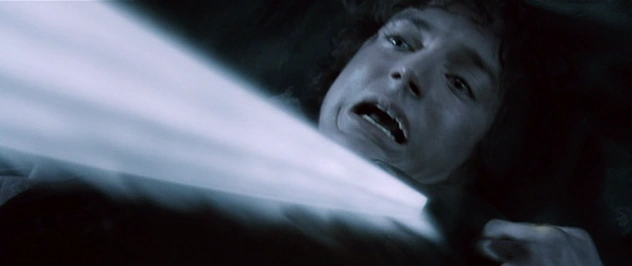
    The first one was a shot I received when I was 13 and I'd broken my collarbone at school. The needle that the doctor used to give me a shot of morphine prior to setting the bone was so large --about 0.25" diameter-- that I could see the hole at the end of the needle clearly. That terrified me, but because I was in such pain and was shoved down onto the table, I couldn't move as the glorified Morgul blade slowly moved in and punctured my shoulder.
    I feel for you, Frodo.
    From lotro.wikia.com.

    The second incident happened when I was much older, and as part of a life insurance application a nurse was dispatched to my house to draw a blood sample. The process was supposed to be simple: draw some blood from a vein in my right arm. While the nurse prepped my arm, I looked away, gritted my teeth and waited for the needle. I felt the needle prick, and then a whole lot of extra, well, movement in my arm. "Does that hurt?" the nurse asked. I glanced over and saw her wiggling the needle in a wide arc while it was still puncturing my arm.

    "Uh....." I began, my brain not really registering what I was seeing.

    "Ah, dammit, I went right through your vein. I'm going to have to use the other arm." She yanked the needle out, put it away, and grabbed a new needle and my left arm.

    After she was finished, my wife said something to the effect of "If you weren't scared of needles before, you definitely are now!"

    Gee, thanks.


  • I once owned a car that had a hole in the floor.

    Seriously.

    The car was a 70s era Plymouth that had more rust on the body than actual metal, and one day I realized the the place where I'd been putting my left foot while driving felt, well, breezy. I checked out the place after I parked, and sure enough there was a heel-sized hole in the floor, with rust flakes all around. All that kept my foot from plunging through the floor and striking the pavement was the carpeting.

    And for the record, I just kind of kept driving the car, but just made sure that I put my left foot someplace else.
  • When I was a teen, my D&D collection was thrown out to save me from the fires of Hell.

    Yes, I'm a refugee of the Satanic Panic that gripped the U.S. back in the 80s. In those days, many parents blamed societal ills affecting their kids on heavy metal music and D&D. This belief was whipped up by the story of James Dallas Egbert III, who allegedly vanished into the steam tunnels underneath Michigan State University in 1979. The reality is more than a bit mundane, but the ordeal and others such as Patty Pulliam's Bothered about Dungeons and Dragons organization pushed D&D into that "SATAN IS COMING FOR YOUR KIDS!!!" mini-hysteria that gripped a lot of parents of that era.

    My parents were no exception.

    I trace my own problems with it to the time my family visited some in-laws of my aunts, who happened to be very much in the Pat Robertson fan club.*** Robertson was one of many televangelists who rode the Satanic Panic bandwagon, constantly warning about Satan's minions trying to get their claws on the American youth.

    While I was at the in-laws place, my brother and I were both separately brought before what I'd call a tribunal of my mom, the in-laws, and my aunt. And we were grilled over D&D for about 5 minutes. I don't recall anything particularly strange about it, but that afternoon it was declared in a family meeting that D&D was now forbidden as tools of the Devil, and the stuff was all collected and thrown out.

    Yes, this was from an actual Jack Chick comic called Dark
    Dungeons. And this was one of the milder forms of anti-D&D propaganda.
    From Geek and Sundry's How D&D Writers Fought the Satanic Panic of the 1980s

    No protests could sway them. Not even the obvious parallels with role playing games and acting helped, because my parents believed**** that acting, playing a role, is fine, but role playing is something else.

    Perhaps more than anything else, those years in the wilderness as far as RPGs are concerned shaped my viewpoint on what RPGs are and how they are played, as well as my views on how religion and power can be misused when people are afraid of something new.

    I had to wait until later --college-- before I really was able to embrace RPGs once more, and I've never looked back.

At this point, I'm supposed to nominate people for this award, but no fear to my reading list, I don't intend to do so. Many of them were nominated already, so there's no reason to re-nominate them. And besides, all good memes have to come to an end anyway.


*Or worse, simply make them up. John Oliver had a great piece on this.

**Admittedly, a running blog is one of the worst things for someone who is a) shy, b) an introvert or c) both to work on.

***If you don't know who Pat Robertson is, count yourself lucky. He's a televangelist who loves to appear during disasters --natural or man-made-- and claim that it is God's wrath that brought about the tragedy. If you Google "Pat Robertson nutty statements" you'll get an idea of what I mean.

****And they still believe it. They also think Harry Potter and the Rick Riordan books lure kids into Satanism, and I've chosen to ignore their disapproval when they see my kids reading Science Fiction and Fantasy novels. The irony is that my parents were the ones who got me into SF&F in the first place with television shows such as Lost in Space and Star Trek, and books such as Lord of the Rings and The Sword of Shannara.


EtA: Added a few links that I'd missed.