Monday, January 29, 2018

On Misinterpreting This Place in the Blogoverse

I'm used to seeing on the blog stats the occasional spike when a web crawler goes through the blog; I just kind of shrug and move on.

This time, however, the junk link is from an actual YouTube video*, so I figured I'd better check to see what the hell is going on.

You know it's bad when the first comment for this particular video is "STOP SPAMMING!" (emphasis mine)....

On the bright side, the "monetization" video had only 700 views, so whatever they were attempting to do, they aren't getting eyeballs. Or maybe they thought PC had thousands of readers or something....


*Sorry, I'm not going to post the link here. Why do the work for them?

Friday, January 26, 2018

Playing Buzzword Bingo

I read with great interest the Kotaku article Bioware Doubles Down on Anthem as Pressure Mounts by Jason Schreier. Basically, Bioware is devoting a ton of resources to make Anthem, their equivalent of Bungie's Destiny, with only a few small development teams working on Dragon Age 4 and SWTOR. The overall feel within Bioware is that the success of Anthem is a make-or-break moment for the company, and if it isn't a success this might be the end of Bioware as we know it.*
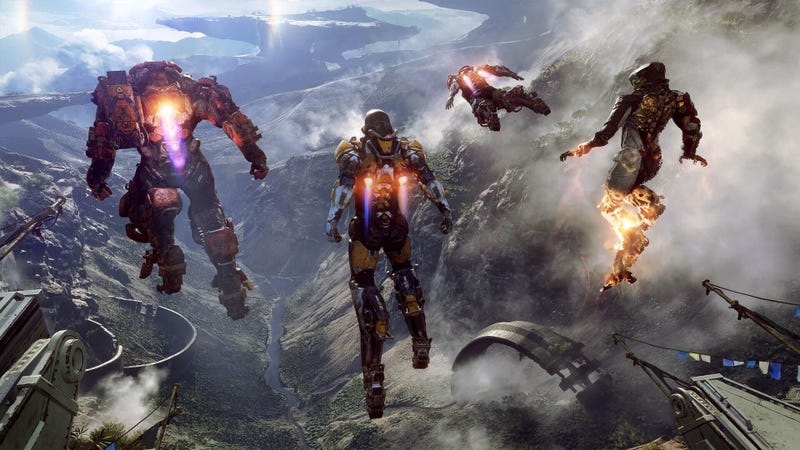
Remember, the fate of hundreds of employees
is riding on your ability to write bug free code.
From Kotaku.com

The sense of a single release having so much of an impact on a game company's fortunes isn't exactly unheard of. Some people were looking at Zelda: Breath of the Wild as Nintendo's last chance to remain relevant in the console wars with the Switch's launch fortunes tied up with the game's release. On the flip side, Microprose's Darklands release back in the early 90s was such a gigantic disaster that it nearly destroyed the company that released Sid Meier's seminal games.
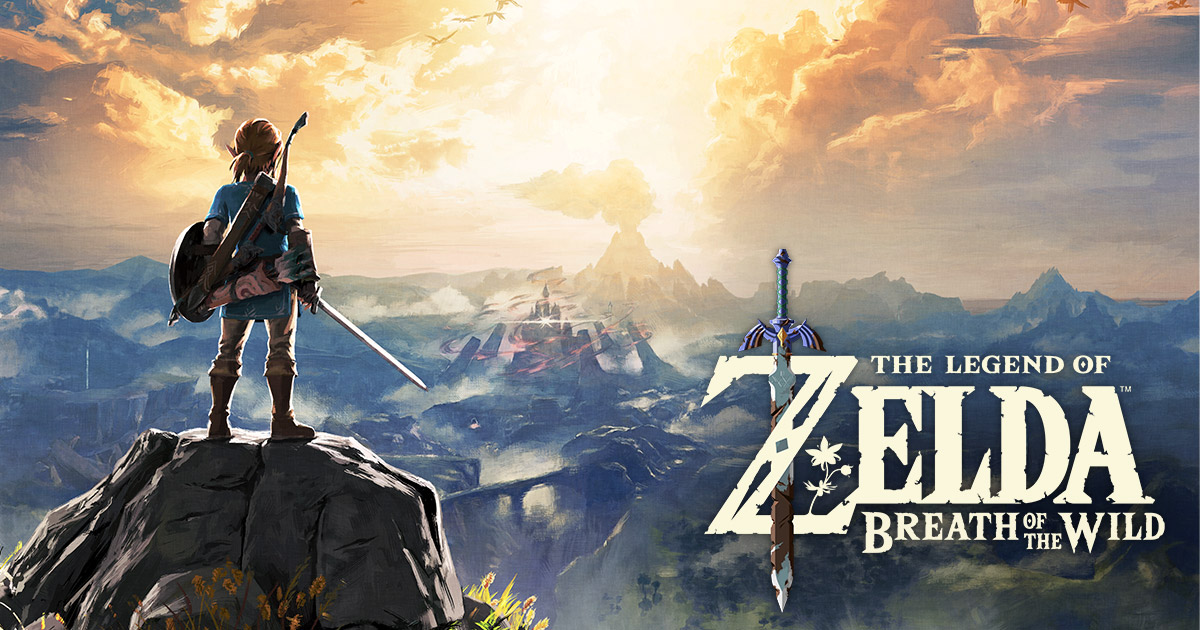
Remember when people were saying that
Nintendo should get out of the console market
entirely after the "failure" of the Wii U?
Yeah, I don't hear that anymore either.
From zelda.com.

Still, it sounds like the struggles with the EA imposed "single solution" of the DICE Frostbyte Engine haven't ended for Bioware. Compared to Unreal, Frostbyte is the muscle car of Engines in that it does one thing well but has... issues... when being expanded into areas where Bioware excels: RPGs. They had issues with Dragon Age: Inquisition and Mass Effect: Andromeda, and it seems that these issues are now continuing in Anthem.**

To MMO players, the fact that Bioware is keeping development of SWTOR going in the face of the "all hands on deck" approach to Anthem is a good thing, but the fact that they had a discussion about putting the game in maintenance mode isn't.

But I made the mistake in reading the comments in Jason's article, and that got me annoyed.

***

A lot of the comments center on a few key points:


  • EA is Evil (as in Disney Villain Evil)
  • Bioware isn't what it once was
  • Anthem will suck because of microtransactions and lootboxes
A lot of the negative comments really break down into variations of "EA is Evil", even when they're talking about the superiority of CD Projekt Red over Bioware in creating RPGs they're basically saying "EA ruined Bioware and EA is Evil!" 

But the thing is, EA isn't Evil in the standpoint of being purely malicious, but rather EA is doing what it does because of their own external pressures. 

Every publicly traded corporation has to deal with the pressure of "what have you done for me lately?" sooner or later. Sure, you get that from your customers --gamers in particular are a prickly lot-- but far more stress comes from investors. If you have a breakout hit, investors will expect you to continue your streak. If a competitor does something that breaks new ground and rakes in a ton of profit, investors will expect you to respond. And not just in a year or two, but yesterday.***

In that vein, the rise of mobile games and the F2P cash shop haven't exactly been helpful to more traditional video game companies. The volume of money made by microtransactions in the mobile arena has inspired Wall Street to push for more monetization of games, while the cash shop has demonstrated that it can keep MMOs afloat in a F2P/post-subscriber world.**** RPGs and MMOs are more expensive to create than this year's edition of Madden, and if they don't make a huge splash the development corporation is left holding the bag. And believe me, Wall Street knows it.
Yes, here's the obligatory quote from Gordon Gecko
in Wall Street (1987). And remember, even more people
agree with this now than they did 30 years ago.
Isn't that a real kick in the ass? 
From giphy.com.

The reality that Wall Street and the pursuit of short term profits are driving the monetization of games and pressuring developers to release on a tight schedule doesn't let corporate management off the hook. People aren't exactly going to be crying for EA's management or Activision Blizzard's Bobby Kotick, and you can make a pretty damn good arguement that good games are released in spite of them rather than because of them. But this is the new way of doing things in corporate development houses. If you're not under extreme pressure to release a buggy product early,***** it could be that your development house is a wholly owned subsidiary of a console maker (such as Horizon: Zero Dawn's Guerilla Games or Nintendo itself) or that your development house doesn't get the spotlight shone upon it by Wall Street, NASDAQ, or the Tokyo Stock Exchange (such as CD Projekt Red, which is on the Warsaw Stock Exchange).

Does that mean that we have to like it when EA gets DICE to slip in microtransactions like they did in Star Wars Battlefield 2? No, but it also doesn't mean that they're tools of Satan, either. Until the economics driving the video game industry change, don't expect video game activism to suddenly convert these corporations into the second coming of Ben and Jerry's. Besides, even Ben Cohen and Jerry Greenfield sold their socially responsible ice cream company to Unilever.

Video game companies can change the way how they do things and tell Wall Street they're not going to chase the last dollar or euro but instead invest for the long term and release when they're ready to do so. You know, like Blizzard does.

But it certainly helps to be able to print money like Blizzard can with WoW (and to a lesser extent Overwatch). Oh, and remember that WoW and the MMOs that preceded it convinced a gamer community that it was okay to actually subscribe to a game rather than simply play it offline like almost all other games that came before. That monetization can be a real bitch, sometimes.
Remember these guys? Mr. Redbeard does.
From Reddit.com.


*Some would argue that the Bioware as we knew it was already gone after ME2 and Dragon Age: Origins, but I don't quite buy that. Bioware still wants to go all in on RPGs as much as they can, but external pressures are forcing them in other directions.

**And I thought that the engine used in SWTOR was considered clunky and difficult to work with!

***When you hear corporate speak about "agility", this is what they mean. In my experience, however, the other corporate standby, "lean and mean", doesn't mesh well with "agility". You need bodies to be agile enough to change direction, and corporations that typically operate as "lean and mean" don't have any spare bodies out there to spearhead that change. (OOO!! Spearhead!! Another corporate slang term! Has anybody won Buzzword Bingo yet?)

****See: SWTOR, LOTRO, Star Trek Online, etc.

*****Or release with tons of microtransactions and other monetization schemes.

Sunday, January 21, 2018

On The Highway Bypass

Blizz rolled out level scaling with the most recent patch, about three expacs later than they originally proposed it.*

However, if you were thinking that level scaling would operate in a similar fashion to that presented on, say, SWTOR, you're in for a surprise.

When I think "level scaling" that means that an implementation similar to that found on SWTOR, where if you have outleveled a zone the game artificially lowers your level down to an arbitrary maximum for the entire zone/planet. If you're in an instance, you're leveled up to the current level cap and your gear/abilities/etc. are scaled up to said level cap. This means everybody is roughly the same "level" in a zone, and eliminates the occasional "surprise!" overleveled area in a zone.**

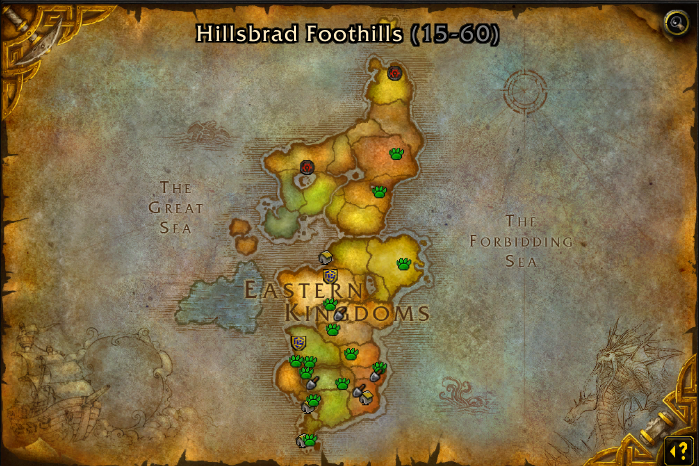
Blizz has implemented a different level scaling system, which is meant to allow a player to avoid certain zones entirely. The idea is a bit more complicated than the SWTOR implementation, where the quests and enemies scale to your level and not the other way around. Additionally, the scaling in the Vanilla area can get a bit confusing as you progress. Go to this link from Wowhead to get the basics of where leveling happens.

From Wowhead. Yeah, I think it odd that Hillsbrad
goes all the way up to 60. Gives a whole new meaning
to those old gankathons on PvP servers at Tarren Mill
and Southshore.


Given the way that Kotaku explained it, you'd get the feeling that story has pretty much been thrown out the window so you can avoid "boring" zones such as the BC leveling zones.

"If you were looking to get into World of Warcraft (or return with a new character), now’s a great time to do it. 

Check out all the changes coming in update 7.3.5, including new questlines and an enhanced S.E.L.F.I.E. camera, in the official patch notes."***

I think that Kotaku is kind of missing the forest for the trees. WoW already had story issues without this level scaling implementation, and now this implementation of level scaling means an acknowledgement that story and questing in the lower zones really don't matter as much as getting you to current content.

As I've said before, WoW's biggest advantage over every other MMO is not the size of its playerbase**** but that it has such a large play area. However, Blizzard's focus on the current expac and raids have imposed external limitations on the size of the WoW universe. Cataclysm's breakage of the storyline continuity made the situation worse, Now, between the "instant L90" (currently "instant L100") that Blizz instituted for Warlords of Draenor and the level scaling, Blizzard has de facto admitted that the leveling zones are merely bumps on the road to get up to speed with the current expac.

If anything, this is a problem imposed by the WoW MMO culture rather than a top down Blizzard design decision. Blizz doesn't really do anything without enough of a desire present in the playerbase, and since the playerbase is primarily oriented toward the current end game Blizzard's changes are designed to get a new toon to the endgame as quickly and painlessly as possible. You can skip the parts you don't like and zip straight to the parts you do like. The thing I find kind of odd about this is that Northrend, Outland, and the Cata zones all had multiple pathways to get you to max level, so if you didn't like Zangarmarsh you could go to Terokkar Forest. Didn't like Borean (Boring) Tundra? Head to Howling Fjord instead. Sure, these provide more options, but it's not like there weren't a lot of options to begin with.

But in the end, I do find it kind of funny that the level scaling allows people to bypass Cataclysm entirely and go straight on to Pandaria; if it weren't for Cataclysm in the first place we'd not necessarily have to have this version of level scaling around.


*A version of this was originally proposed for Cataclysm, and I looked at the possibility with a great deal of interest. I'd be able to play with friends who were at max level on other servers but without them having to create a new alt just for that purpose.

**Getting one shot in some areas of, say, Alderaan and Tatooine teaches you to avoid certain areas like the plague. Still, trying to explain to the noob not to go over that specific hill can be more trouble than its worth.

***From that Kotaku article.

****Which is now an unknown anyway.

*****with the exception of the Wrathgate in Northrend that you pretty much had to do in order to progress to the end of the Northrend questlines.

Thursday, January 18, 2018

Ow

Winter colds are never fun.

And winter colds with sinus pressure....

By George Cruikshank.
Art Institute of Chicago

Yeah, it's been a helluva week.

This has gotten me to thinking about that one legacy of the original D&D rules that is found in just about every video game or RPG: the hit points/health bar.

The ol' HP system was an arbitrary value designed to illustrate the overall improvement in skill and whatnot in a player character (PC). Originally, Gary Gygax wrote that a player's "true" health points are about the last 1-6 HP in their overall value, and the rest represented the gradual wearing down of the PC by dodging and deflecting blows.* To use a pro wrestling analogy, in the Rick Flair ESPN documentary there was a mention about the training regimen for a pro wrestler and that you had to learn how to use the ropes in a boxing ring. When you start out, when you bounce off those ropes they tear at your skin and leave a bloody trail all over your back, chest, and arms. After a few weeks, however, your skin toughens up and that stops happening. Essentially, the pro wrestler gains HP by training and a "low level" injury doesn't hurt anymore.

That being said, I still think the HP system is a bit of a goofy rationale for how things work in real life. Not everybody can withstand the damage that was inflicted on John McClane in Die Hard.

From tvtropes.org.
If realism is the angle we want, something like GURPS' method of health being strictly a low number of roughly 6 is about right.** But that doesn't exactly lend itself to what we'd call "heroic" combat like that found in most standard RPGs (such as D&D) or video games (such as, well, most of them).

The easy way to show that a player's toon is getting better is to let numbers increase, and that includes health. It also eliminates the possibility of the (rather embarrassing) situation where a powerful L60 Warrior gets one shot by a "You no take candle!" Kobold in Elwynn Forest. Raising a player's health is also an easy way to show the power in higher level enemies. Go wander into the old Scarlet Monastery area in Vanilla WoW with a new Horde toon, and even if you manage to land a blow to one of those L30ish Scarlets swarming around outside the Monastery it won't be enough to make a dent in their much higher health numbers. ("No one-shots for you!")

Still, not all MMOs these days follow this dictum, as SWTOR is the best example of adjusting (lowering) your toon's level and stats to match the area you're located in. You won't be able to zip along in Coruscant as an L60 Jedi without having to worry about the Black Sun aggroing on you, but neither will you have to worry about the Dread Lords' zones in places such as Alderaan insta-killing you, either.

I guess the guiding principle here is what the design goals for the game in question are. Is it realism or heroism? While you can be "heroic" in a game heavily tilted toward realism, my experience in playing the heavily realistic games is that you tend to play the game much more cautiously, which doesn't really pass the "heroic" test in my book. The more heroic the game --and the more liberal the implementation of the HP stack or health bar-- the more likely it is that a player will go and perform reckless actions that certainly qualify as more heroic. (Cinematically speaking, anyway.) Both design goals have a place in gaming, but I personally tend to prefer the more heroic end of the spectrum. I loosen up a bit when I see a decently sized health bar, and I'm more apt to throw myself at a (non-boss) fight without worrying too much about trying to be perfect in my attack rotation.

Now, if you'll excuse me, I have to finish getting my personal health bar back up to full.


*He must have written that in an old issue of Dragon Magazine, because I can't find it in my AD&D 1e books. Then again, the organization of the 1e books left a lot to be desired, so I suppose it's not a great surprise that I can't find it in there on the drop of a hat.

**GURPS stands for Generic Universal Role Playing System. For those who have never heard of it, yes, it is a real RPG system put out by Steve Jackson Games. And as the name makes blindingly clear, the point of GURPS is that you can take the system and apply it to just about every setting imaginable. Unlike some other universal RPG systems --such as Pinnacle's Savage Worlds-- GURPS is very detailed. While the mechanic --3 six sided dice-- is very simple, the devil is in the details and the setup. Most of the problems people have with GURPS is getting their characters and the setting set up right; once that's done, the system is very simple. (Relatively speaking, of course.) A long time ago --when the mini-Reds were very young-- I considered making a GURPS Lite campaign using the Disney Fairies as a setting because the girls were massively into that at the time. But as you can guess, I didn't have the time to work out the details so I passed on it.

Tuesday, January 9, 2018

Full Plate and Packing Steel

Guess what I've been playing with this past week?

A certifiable blast from the past.
Yes, the second game Bioware ever created, Baldur's Gate.*

I played BG back in late 1999-early 2000, when a friend loaned me the 6 CD set.** There's a bit of a slow part in the mid area, when you're trying to get to a high enough level to gain access to the city of Baldur's Gate itself, but so far the game has really aged well in terms of storyline.

Sure, the sprite images look ancient, but the gameplay remains surprisingly intuitive. The environment simply fits with the D&D system, and it's not hard to pick up and start playing. And boy, the core rules are pretty unforgiving when you use them here. 

I'm up to Chapter 3 --not an "already??" moment, because you spend a lot of time raising your level by doing side quests-- and I've found that I really had to stuggle to get through the end of the Nashkel Mines dungeon. I became reacquainted with the "rest" feature in the area where the soldiers are posted, because otherwise we'd not have enough spells to make it through. And that last fight...

Hoo boy.

I can't wait to keep going.


*I always figured it was the first game, but it turns out they created Shattered Steel first.

**That dates BG right there; you learned to listen for the change in the CD access sound so you knew what event was about to happen.

Friday, December 29, 2017

A Rarity in the Wild

The more I watch the mini-Reds play Breath of the Wild, the more I'm impressed by the work that went into the game's development.

The level of detail that went into placing the shrines and the Korok Seeds, for instance, took a lot of effort. And that was just a small part of the game itself. Sure, the game suffers from that bane of open world games, the giant impenetrable barrier at the edge of the game world*, as well as the grind that can wear people down, but every last detail that Nintendo's dev staff went into the latest Zelda offering is quite amazing.

Without bugs, no less.

Write that last part down and stare at it for a little while: no bugs.

In an age where bugs in software are pretty much standard fare, Nintendo released a (nearly) bug free game with a gigantic amount of detail into the wild. Compare and contrast with Mass Effect: Andromeda and Assassin's Creed: Unity**, which were so buggy on release they required major updates just to be playable.

What's the difference?

The biggest thing that jumps out at me was that Nintendo decided to delay release of Breath of the Wild until the Switch was announced and released, which had the effect of giving the devs an extra year to hammer everything out. Nintendo also channeled the Blizzard release process in that they released only when they felt the game was ready, which was no small deal given the amount of pressure Nintendo was under for the Switch's launch to be a success.***

Another item Nintendo focused on was the graphics and sound experience. Voice acting in Breath of the Wild was limited primarily to the cutscenes, so that kept some annoying problems related to integrating voice acting into the game**** from cropping up. The graphics were designed to exploit the Wii U first, and were never designed to be truly cutting edge 4K. The artistry that went into Breath of the Wild was more important than the realism and detail, which meant that graphical problems were largely avoided.

Finally, Nintendo knew what they wanted and they had a long time to develop it. Sure, the platform changed during development, but apparently the differences in those platforms were minimal enough that the Zelda team could focus on the actual development and not worry about performing cross system development such as that found with XBox and PS4 (and PC). Like Apple's own development environment, having complete control over the hardware means that you can limit bugs to an exceptional degree.

My hat's off to Nintendo for their exceptional work in Breath of the Wild. It's the sort of game that I'd love to play if the ability to lock the viewing direction into an MMO mode (such as that found in most Western MMOs, such as WoW, SWTOR, or LOTRO) were available. As it is, I'm happy to watch the mini-Reds play. (Well, until I get a headache from the viewing angle changes, that is.)


*But really, there hasn't been an open world RPG or MMO that has created an entire globe, so that's kind of a "meh" problem if you ask me.

**Or, back in the day, Darklands by Microprose.

***Mission accomplished, there. The Switch is, so far, a big success story for Nintendo given the amount of positive press it got as well as the excellent choice in games released for the platform.

****Such as the mouth and visual problems ME:A had on launch, or the problems ArcheAge has with NPCs speaking in Korean in the English version of the game.

Saturday, December 23, 2017

An MMO Quickie

LOTRO is having its annual Winter Themed Event, the Yule Festival, with an elk as one of the available mounts.

Like this. From lotro-wiki.com.

I took one look at the mount and quipped "This looks just like the elk mount an Elf gets on ArcheAge."

For some reason the mini-Reds weren't so amused about that.